
Smart integration of road and rail in freight transport
The Auto-Load project is driving the future of logistics automation
Many logistics processes are still carried out manually—which is time-consuming, prone to errors, and often not very sustainable. This is precisely where the Auto-Load research project comes in: Together with three partners, Rotte is working to make freight logistics more interconnected and automated.
According to the Federal Ministry of Transport, approximately 1.3 million trucks travel on German highways every day to transport goods. At the same time, over 51,000 trains use the rail network—including numerous freight trains that play a central role in the economy. However, both modes of transport face similar challenges: a lack of automation and connectivity. Train formations are assembled manually, and the loading and unloading of containers and palletized goods is also largely done by hand. While road transport is also burdened by high CO₂ emissions, rail transport is reaching its infrastructural limits.
Translated with DeepL.com (free version)
“Existing transport systems have so far been poorly coordinated and do not work together effectively,” explains Franz-Barthold Gockel, Managing Director at Rotte. Yet the advantages are clear: freight trains are particularly efficient over long distances, while trucks excel at short-distance transport and the so-called ‘last mile.’ It is precisely this combination that the Auto-Load project aims to optimize through automated loading and unloading processes.
Greater efficiency through the automation of loading and unloading processes
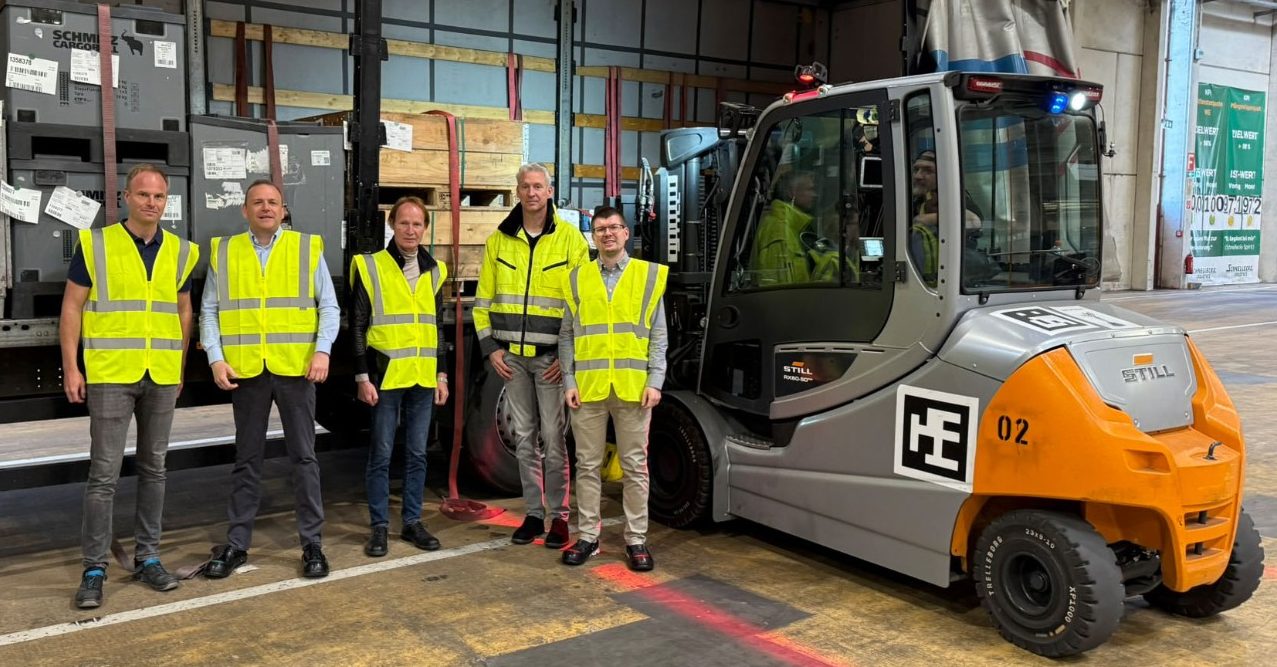
A key approach to achieving more sustainable freight transport is the intelligent integration of road and rail. This is based on the automated handling of loading units. Technologies for identifying, locating, and moving goods enable automated loading and unloading—initially at the Schmitz Cargobull AG warehouse.
Optimized loading strategies ensure that available cargo space is utilized more effectively. This makes it possible to reduce the number of vehicles required. The goal of Auto-Load is to make logistics processes more efficient and safer, reduce costs, and sustainably strengthen the industry’s competitiveness.
Demonstrator highlights potential
As part of the project, the participating experts are analyzing requirements and interfaces for automated processes. At the same time, technical system components are being developed and integrated. This effort is underpinned by Rotte’s extensive expertise in mechatronics, automation, robotics, systems engineering, image processing, and data analysis.
Together with the project partners, a demonstrator is being developed that clearly illustrates the potential of automated freight loading. “With Auto-Load, we are making an important contribution to more sustainable freight transport,” emphasizes Tobias Thebille, Head of Electrical Engineering at Rotte.
Background on the Auto-Load Project
The Auto-Load research project will run from May 2025 to 2028 and is funded by the Ministry of Economic Affairs, Industry, Climate Protection, and Energy of the State of North Rhine-Westphalia, as well as by the European Union under the ERDF/JTF program. The consortium includes Fraunhofer IEM, Schmitz Cargobull AG, Ulrich Rotte Anlagenbau und Fördertechnik GmbH, and verlinked GmbH. The project is supported by the associated partners Schnellecke Logistics and SE DB Cargo AG, as well as the Project Management Agency Jülich (PtJ).