
Automated Handle Rail Assembly
Robot-assisted assembly of handle strips in furniture production
Automated handle strip assembly refers to the robot-assisted provision, detection, positioning, fastening and inspection of handle strips on furniture fronts and other furniture components. Rotte develops customised systems for this purpose that process handle strips made of aluminium, wood or plastic with precision and flexibly accommodate different front formats, profiles and fastening methods. Depending on the product, handle strips are inserted into milled grooves and secured with a form-fit and force-fit connection by gluing, screwing or clips. Robotics, gripping technology, sensor technology, optional image processing and intelligent control systems ensure reproducible assembly quality, stable processes and fewer manual interventions in industrial furniture production.
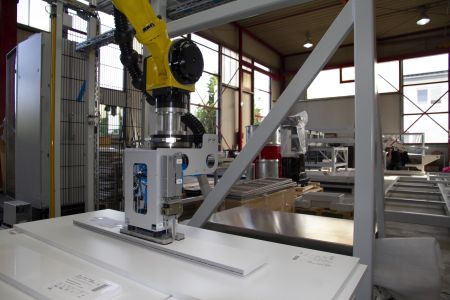
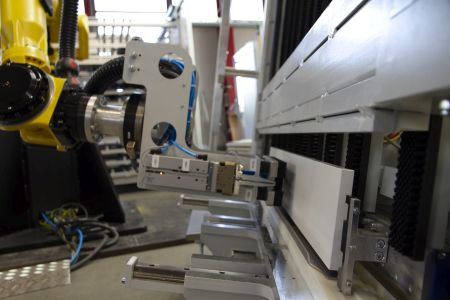
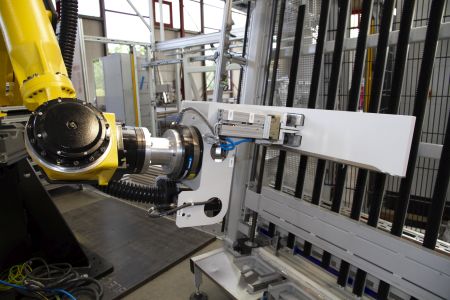
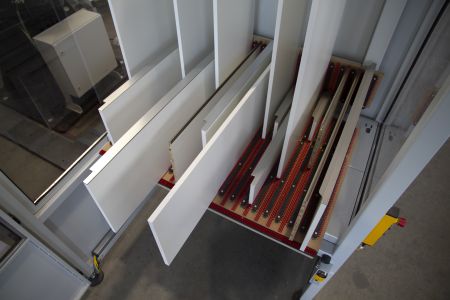
What does automated handle strip assembly do?
In automated handle strip assembly, recurring work steps such as providing, detecting, gripping, aligning, positioning, inserting, gluing, screwing, clipping and inspecting are carried out by an individually designed system. The aim is a reproducible and precise connection between the handle strip and the furniture front. Especially where there are many variants, high quality requirements or recurring manual operations, automation can help to reduce errors and rework, relieve employees ergonomically and stabilise assembly quality regardless of the operator.
Automated handle strip assembly is particularly useful when handle strips are fitted in recurring processes, in large quantities or with high visual and quality requirements. Increasing quantities, fluctuating quality in manual assembly and ergonomically demanding tasks are also arguments in favour of an automation solution.
Which solution is economical depends, among other things, on the quantity, variety of variants, front formats, fastening method, cycle time and the desired degree of automation.
Case Study
Automated handle strip assembly for variable front formats and profiles
- Handle strip widths in the system example: 300 to 1,200 mm
- Fronts/panels in the system example: 287 to 1,200 mm wide and 144 to 1,400 mm high
- 5 handle strip types in the system example described
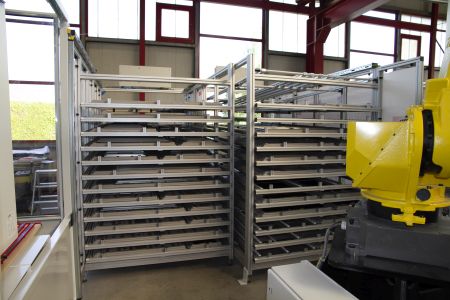
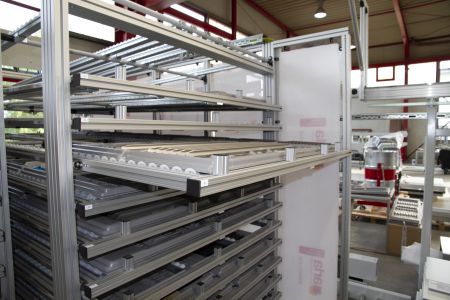
- 1 to 3 racks with 12 levels each: up to 3,528 handle strips can be stored
- Output per cell: 1 to 2 parts per minute
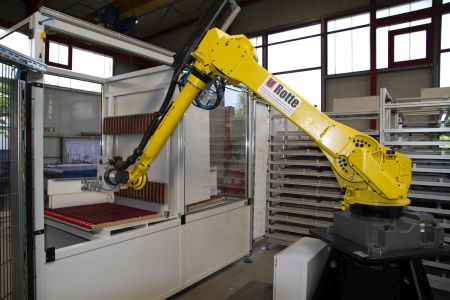
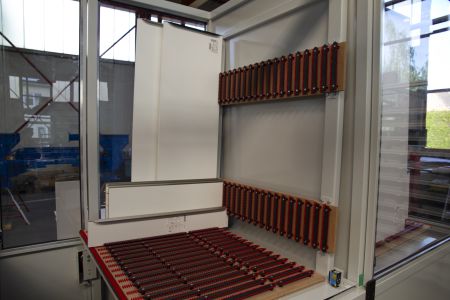
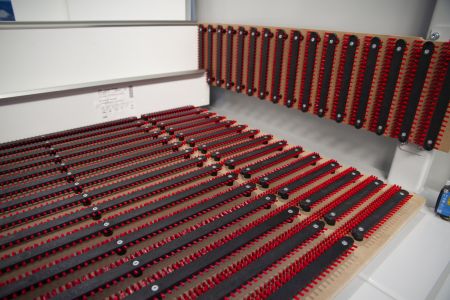
Rotte’s existing system example is designed for a wide variety of variants in furniture production. It processes handle strip widths from 300 to 1,200 mm as well as fronts and panels with widths from 287 to 1,200 mm and heights from 144 to 1,400 mm. Five handle strip types can be handled in the system described. Depending on the configuration, one to three racks with twelve levels each are available, allowing up to 3,528 handle strips to be stored. The specified output is one to two parts per minute per cell.
Initial Situation
In furniture production, handle strips in numerous widths and five different types were to be fitted to fronts and panels of a wide range of formats, reproducibly and with as little manual effort as possible.
Requirement
The system was to store a large number of handle strips, recognise variants, process handle strip widths from 300 to 1,200 mm and flexibly cover fronts from 287 to 1,200 mm wide and 144 to 1,400 mm high.
Solution by Rotte
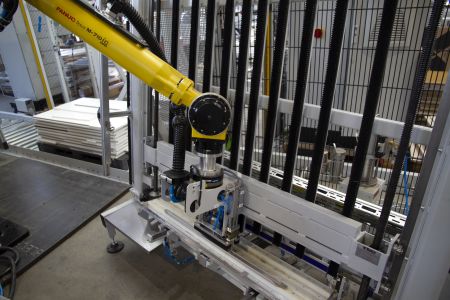
Rotte developed a robot cell with rack-based supply from one to three racks with twelve levels each, customer-specific gripping technology, sensor technology for position detection and a joining unit tailored to the respective fastening method.
Result
The system stores up to 3,528 handle strips, processes a wide variety of variants in an automated process and achieves an output of one to two parts per minute per cell.
Manual vs. automated handle strip assembly
Manual handle strip assembly remains flexible for small quantities, one-off productions or frequently changing special tasks. With recurring series, many variants and high visual requirements, however, quality depends more heavily on manual alignment, positioning and fastening. Automated handle strip assembly carries out defined process steps reproducibly, processes stored variants in a controlled manner and can integrate position control and quality inspection directly into the assembly process.
Manual Assembly
- Quality highly dependent on the operator
- Manual alignment and positioning required
- Higher risk of positional deviations and rework
- Ergonomic strain due to repetitive movements
- Variant changes require a high level of attention
- Cycle performance only scalable to a limited extent

Automated Assembly
- Reproducible positioning and fastening
- Integrable position and quality control
- Predictable cycle times and defined material flow
- Relief for employees in repetitive tasks
Semi-automated manufacturing:
- Individual process steps automated
- Manual provision of fronts or handle strips
- Integration of Manual and Automated Process Steps
- Employees will continue to perform certain tasks
Fully Automated Manufacturing:
- Combination of feeding, component recognition, gripping, positioning, joining, inspection and onward transport
- High process stability and reproducible workflows
- Variants can be processed automatically depending on the system concept
- Particularly suitable for recurring series and clearly defined process chains
When is automated handle strip assembly worthwhile?
Automated handle strip assembly is particularly useful when handle strips are fitted in recurring processes, in many variants or with high visual and quality requirements. Typical benefits include:
High fitting accuracy: Robots position handle strips reproducibly and align them precisely to the front, milled groove or defined reference points.
Less rework: Automatic position control and defined joining processes reduce incorrectly positioned or incompletely fastened handle strips.
Variant capability and short changeovers: Different front formats, strip lengths, profiles and materials are processed under program control, depending on the system concept.
Ergonomic relief: Employees are relieved of recurring gripping, alignment and fastening tasks.
Process and quality control: Sensor technology and optional image processing check component position, dimensions and deviations and provide inspection data for quality assurance.
Which processes can be automated?
An automated system can take over the entire process chain of handle strip assembly. First, the handle strips are fed to the assembly cell from racks, magazines or project-specific supply systems. Sensor technology and optional image processing then detect the front format, handle strip variant, position and orientation of the components and assign them unambiguously. Robots with product-specific grippers pick up the handle strips and position them precisely at the intended assembly position.
Depending on the product, the handle strips are then inserted into milled grooves or fastened by gluing, screwing or clips. Position, dimensional and completeness checks detect deviations directly in the process, and process and inspection data can be documented on request. Finally, the system transfers the finished fronts to downstream production steps and integrates them into the existing material flow.
Which technologies are used in automated handle strip assembly?
The success of our systems is based on the interaction of robotics, gripping technology, sensor technology and intelligent control. That is why Rotte does not develop a rigid standard system, but an automation concept from special machine construction that is tailored to the respective production.
Robotics: Industrial robots take over gripping, alignment, positioning and other recurring assembly tasks.
Gripping technology: Individually designed grippers handle different strip lengths, profiles and materials gently and with process reliability.
Sensor technology and image processing: Camera systems and sensors detect component position, dimensions, orientation and deviations, safeguarding the assembly process.
Gluing, screwing and clip technology: The joining unit is tailored to the respective fastening method, from adhesive application to screwing or clipping.
Feeding and conveyor technology: Racks, magazines and conveyor technology supply handle strips and fronts as required and connect the system with upstream and downstream processes.
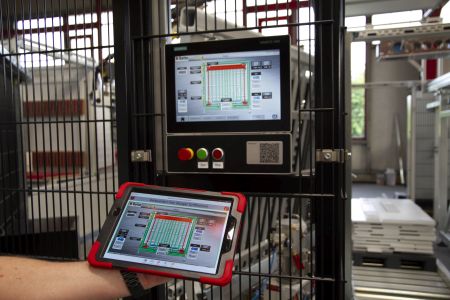
Control and quality data: The system control coordinates variants and process steps. On request, inspection and process data are stored for quality assurance.
Automated handle strip assembly for different furniture sectors
Automated handle strip assembly is suitable for various areas of industrial furniture production. The decisive factors are front geometry, handle strip profile, material, fastening method, variety of variants and the desired integration into the overall process. The existing product page lists kitchen, bathroom and living room furniture in particular, as well as various profile and design solutions as fields of application.
Kitchen furniture: Assembly of recessed or surface-mounted handle strips on kitchen fronts with different widths, profiles and design variants.
Bathroom furniture: Precise handle strip assembly on compact, high-quality fronts with high demands on appearance and repeat accuracy.
Living room furniture: Automated processing of profile handles and handle strips on modular living room furniture, sideboards and cabinet fronts.
Fronts with milled groove: Automated insertion of handle strips into prepared milled grooves with a defined position and reproducible alignment.
Surface-mounted profiles: Assembly of handle strips that are fixed to the front by gluing, screwing, clips and comparable fastening methods.
Variant production: Flexible processing of different front formats, strip lengths, materials and profile types in series and high-variant production.
Project workflow with Ulrich Rotte
1. Analysis
Fronts, handle strips, profiles, materials, fastening methods, variants, cycle times and quality requirements are evaluated together.
2. Concept
Rotte develops an individual assembly and material flow concept and checks technical and economic feasibility.
3. Design
Robot cells, grippers, material supply, joining units, sensor technology, safety technology and control systems are designed in detail.
4. Manufacturing
Machine assemblies, grippers, fixtures and other system components are manufactured and assembled.
5. Commissioning
The system is tested, accepted and integrated into the existing furniture production as well as upstream and downstream processes.
6. Service & Optimisation
Training, maintenance, inspections, software adjustments and optimisations as required ensure long-term operation.
Individual solutions for your furniture production
Handle strips differ in length, profile, material and fastening method. At the same time, furniture fronts vary in dimensions, milling, surfaces and design. That is why Rotte does not develop a rigid standard system, but an automation concept tailored to the respective production. Among other things, component feeding, gripping technology, sensor technology, image processing, gluing, screwing or clipping processes, quality inspection, cycle time, variant handling and interfaces to upstream and downstream systems are taken into account. The result is a solution that fits your individual furniture production both technically and economically.
FAQ – Frequently asked questions about automated handle strip assembly
What is automated handle strip assembly?
Automated handle strip assembly is a robot-assisted process in which handle strips are fed, detected, positioned, fastened and inspected on furniture fronts.
Which handle strips can be assembled automatically?
Rotte processes handle strips made of aluminium, wood and plastic. Which profiles and materials are possible in each individual case depends on the individual gripping and joining system.
How are handle strips fastened?
Depending on the product, handle strips can be inserted into milled grooves or fastened by gluing, screwing or clips.
Can different front formats and handle strip variants be processed?
Yes. The system is designed for the respective dimensions, profiles and variants. Sensor technology, programs and optional image processing support flexible variant processing.
What output does automated handle strip assembly achieve?
In Rotte’s system example, the output is one to two parts per minute per cell. The actual performance depends on the product, process, fastening method and system configuration.
What dimensions does the existing system example process?
The system example processes handle strip widths from 300 to 1,200 mm as well as fronts and panels from 287 to 1,200 mm wide and 144 to 1,400 mm high. For other formats, the system is designed individually.
Can handle strip assembly be integrated into existing production lines?
Yes. Rotte adapts robotics, feeding, control, conveyor technology and interfaces to the existing production environment and downstream processes.
How does an automation project with Ulrich Rotte work?
A project begins with the analysis of fronts, handle strips, variants and processes. This is followed by concept development, design, manufacturing, assembly, testing, commissioning, training and, on request, long-term service and optimisation.

One Company, Many Advantages
Ulrich Rotte Anlagenbau & Fördertechnik GmbH is your specialist in custom machinery. In addition to our innovative solutions in special-purpose machinery and automation technology, you also benefit from a wide range of customer and after-sales services:
Your Advantages at a Glance:
- Decades of experience in special-purpose machinery
- Extensive know-how across all areas of automation technology
- High expertise in the latest technologies and applications for Industry 4.0
- All services from a single source—from development and design to manufacturing, assembly, commissioning, and regular on-site maintenance
- Optional training of your machine operators, technicians, and supervisors at your facility
- Mechanical engineering made in Germany – we design and manufacture exclusively in Germany
- Personalized customer support – you will always have a qualified contact person available


